

Esta entrada también está disponible en: Spanish
HOW DO WE KNOW THE BIBLE IS THE WORD OF GOD?
One of the most controversial topics in theology and contemporary culture concerns the veracity and authority of the Bible as the Word of God. Many groups, both atheists and “progressive Christians,” have undermined the authority of the Bible to such an extent that it is no longer even considered a good moral book. If anything, in today’s culture, many consider it to be the thoughts of archaic people about what they believed about GOD, but that it has little relevance and little or no authority for our daily lives.
In this writing, we are going to debunk these ideas by formulating and defending a
DEDUCTIVE ARGUMENT FOR THE AUTHORITY AND INERRANCY OF THE BIBLE.
The doctrine of inerrancy can be simply defined by the following statement:
“The Bible (in its original manuscripts) is true, free from errors and falsehoods in all that it teaches and affirms.”
It also means that GOD has truthfully revealed, in common language, what he wanted to express to human beings.
This does not mean that rhetorical freedoms used in various literary and discursive genres cannot be included. Nor are rhetorical figures, paraphrases, approximations, etc., considered “errors,” just as they are not considered so in ordinary communication. So-called “grammatical errors” are not ‘errors’ at all; grammar is a function of usage. Thus, for example, when JESUS says that the mustard seed is the “smallest,” the Master is not teaching a botany class. He is using a local analogy to explain a spiritual truth. We know that there are smaller seeds, but in the regional context in which JESUS operated, the mustard seed would be understood by his immediate audience, in effect, as “the smallest seed.”
Christians generally argue in circles (the fallacy of affirming the consequent or begging the question) to try to prove the inerrancy of Scripture. For example, they say, “The Bible is inerrant because the Bible is the word of GOD.” And how do we know that the Bible is the Word of GOD? Because the Bible says so.
Although there are theologians who simply assume or derive inerrancy inductively, I believe that inerrancy is something that can be deduced from the person and authority of Jesus Christ by taking certain writings in the Bible as a set of historical documents using the same standards of historiography that apply to any ancient writing.
The argument is anchored in the same historical event that underpins Christianity in general: The Resurrection of JESUS:
Why Christians believe that the Bible is the infallible Word of GOD:
- JESUS claimed to be GOD.
- JESUS rose from the dead, validating His claim.
- Everything GOD teaches is true.
- JESUS taught that the Old Testament is the Word of GOD.
- JESUS authorized the apostles to teach in His name.
- The New Testament is the written testimony of these apostles.
- Conclusion: The Bible (Old and New Testaments) is the Word of GOD—true, authoritative, and without error.
Next, we will justify both historically and biblically the complete and expanded argument above. I would like to point out that the argument is deductive and adheres to the laws of logic: that is, if the premises of the argument are true, then the conclusion is necessarily true.
Complete Deductive Syllogism in Favor of the Authority and Inerrancy of the Bible (with References)
Part I: The Divine Identity of Jesus (Historical Foundation)
In this section, although we have included references from the New Testament, the premises are based exclusively on historical evidence.
P1. JESUS claimed to speak with divine authority.
That JESUS spoke with divine authority is recognized as a historical fact. This means that in multiple independent sources, JESUS considered himself to be the Messiah and the Son of Man (a messianic title with divine authority). His enemies also accused him of usurping GOD’s throne (accusing him of blasphemy), and his followers considered him to be the Son of GOD. For a complete historical treatment and defense of this premise, see this series of articles (in order):
- Challenge: Jesus never said, “I am God.”
- The Deity of Jesus: A Defense. Part 1: Introduction
- JESUS Receives Honors Due to GOD
- JESUS Shares the Attributes of GOD
- JESUS Shares the Names of GOD
- JESUS Shares the Acts of GOD
- JESUS Shares the Throne of GOD
Related verses (for a believing audience):
▪ John 10:30 – “I and the Father are one.”
▪ Mark 2:10 – “The Son of Man has authority on earth to forgive sins.”
▪ Matthew 5:21-22 – “But I tell you…” (JESUS speaks with authority about the Law).
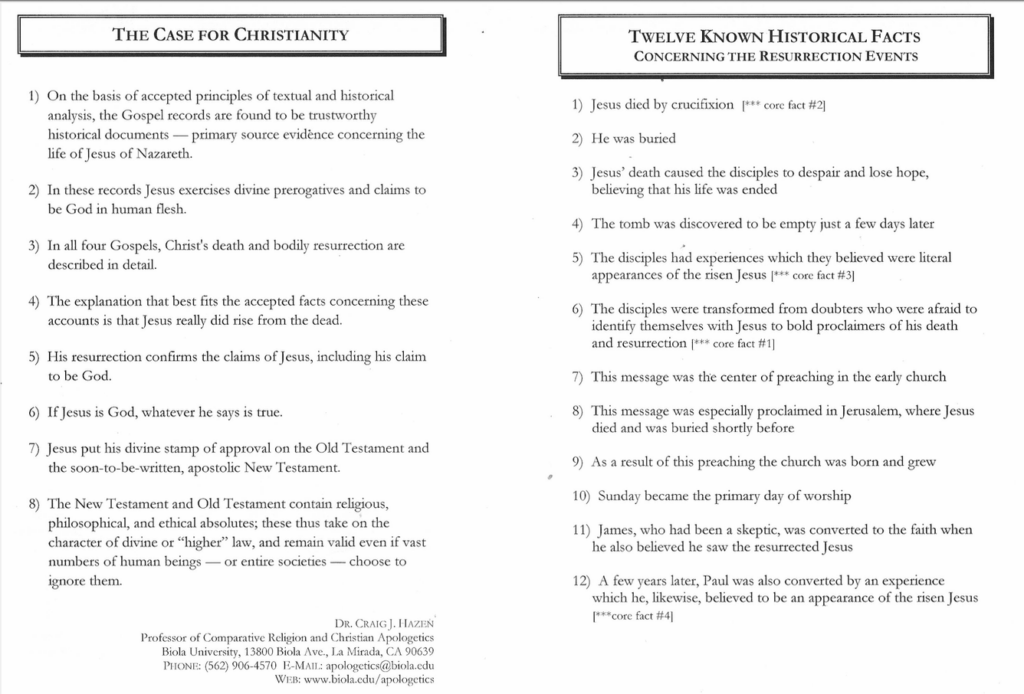
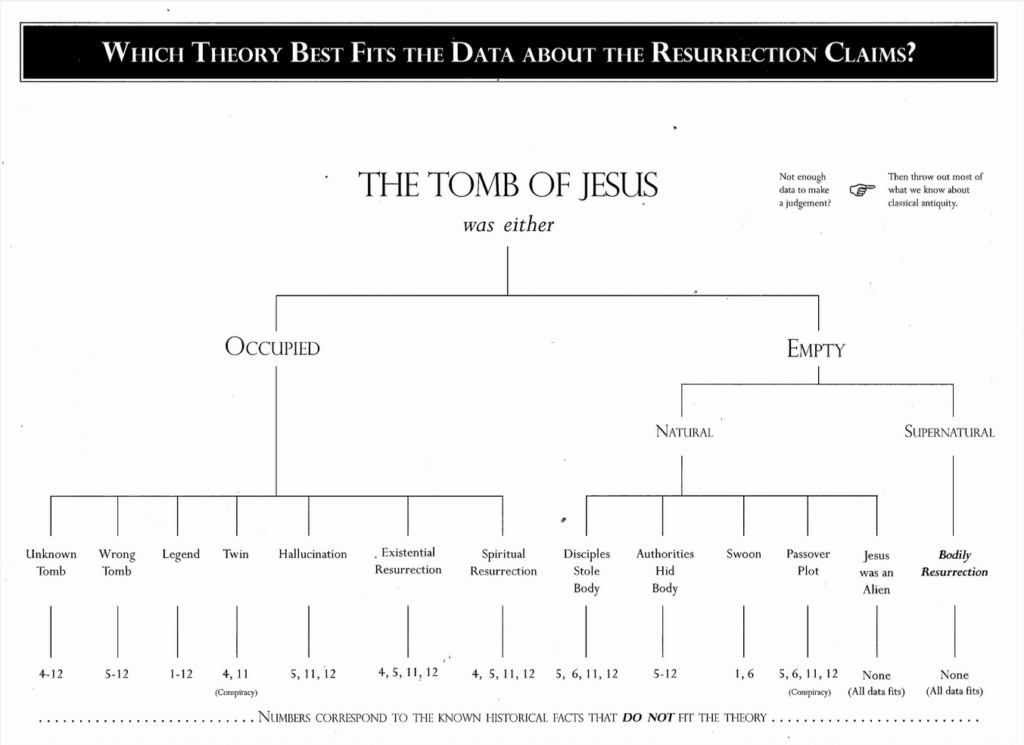
P2. JESUS was crucified, buried, and His tomb was later found empty.
▪ Mark 15:37-47 – Death and burial of JESUS.
▪ Mark 16:1-6 – The empty tomb.
▪ Matthew 28:5-6 – “He is not here, for he has risen…”
P3. Multiple independent sources attest to the post-mortem appearances of JESUS.
▪ 1 Corinthians 15:3-8 – JESUS appeared to Peter, to the Twelve, to more than 500, to James, and to Paul.
▪ Luke 24:36-43 – JESUS physically appears to the disciples.
▪ John 20:27-29 – Thomas touches the risen Christ.
P4. The best explanation for these events is that GOD raised JESUS from the dead.
▪ Romans 1:4 – “…declared to be the Son of GOD with power… by his resurrection from the dead.”
▪ Acts 2:32 – “GOD raised this JESUS, and we are all witnesses of this.”
C1. Therefore, GOD vindicated JESUS’ claims, including His claim to be divine.
▪ Acts 17:31 – “…He has given assurance to all by raising Him from the dead.”
▪ John 2:19-21 – JESUS predicted His resurrection as proof of His authority.
Premises P2, P3, and P4 form the basis of the historical argument for the resurrection, and as such, they are amply justified by the following chart (you can download it to your phone or computer).
If you prefer to explore the detailed argument, you can find it in the following more academic paper:
Resurrection de JESUS.
A third option: You can watch this video with the complete historical argument in favor of the resurrection below.
C2. Therefore, JESUS is GOD.
This conclusion follows from the preceding premises: JESUS claimed to be divine, and GOD gave His “seal of approval” to these claims by raising Him from the dead.
▪ John 20:28 – “My Lord and my GOD!”
▪ Colossians 2:9 – “For in him dwells all the fullness of the Godhead bodily.”
▪ Hebrews 1:3 – “He is the radiance of the glory of GOD…”
Part II: The Teaching Authority of JESUS
P5.Everything GOD teaches is true and without error.
This is because GOD is a morally perfect being; He is the greatest conceivable being and therefore does not deceive. GOD is not a deceiver, and therefore if He teaches you to believe something, what He teaches you is true.
▪ Titus 1:2 – “GOD… never lies…”
▪ Hebrews 6:18 – “…it is impossible for GOD to lie.”
▪ Psalm 12:6 – “The words of the LORD are true…”
▪ John 17:17 – “Your Word is Truth.”
P6. JESUS is GOD (from C1).
See also the justification for Premise 1.
▪ John 1:1, 14 – “The Word was GOD… and the Word became flesh.”
▪ John 14:9 – “He who has seen Me has seen the Father.”
C3.Therefore, everything JESUS teaches is true and without error.
▪ John 8:45-46 – “Which one of you convicts Me of sin? If I tell the truth, why don’t you believe Me?”
▪ Matthew 24:35 – “Heaven and earth will pass away, but My words will never pass away.”
Part III: JESUS’ view of Scripture and apostolic authority
P7. JESUS taught that the Old Testament Scriptures are the inspired, authoritative, and inerrant Word of GOD.
▪ Matthew 5:17-18 – “Not one jot or tittle shall pass from the Law…”
▪ John 10:35 – “The Scripture cannot be broken.”
▪ Luke 24:44 – “Everything written about Me in the Law… must be fulfilled.”
P8. JESUS commissioned His apostles to teach in His name and promised that the Holy Spirit would guide them into all truth.
▪ John 14:26 – “The Holy Spirit… will teach you all things and remind you of everything I have said to you.”
▪ John 16:13 – “When the Spirit of truth comes, He will guide you into all truth.”
▪ Matthew 28:18-20 – “All authority… Go therefore and make disciples… teaching them to observe all that I have commanded you.”
P9. The apostles and their close associates wrote the New Testament under divine guidance.
We also know that the Apostle Paul, in his writings, already quotes multiple passages from the Gospels. This means that the Gospels (or at least a significant portion of the Gospels) were already known to Paul:
Paul: Evidence for the Early Dating of the Gospels
▪ 2 Peter 3:15-16 – Paul’s letters are called “Scripture.”
▪ 1 Timothy 5:18 – Paul quotes both Deuteronomy and Luke, calling both “Scripture.”
▪ Ephesians 2:20 – The church is “built upon the foundation of the apostles and prophets.”
To Know More: When Were the Gospels Written and by Whom?
C4. Therefore, the New Testament shares the same divine authority as the Old Testament.
▪ 2 Timothy 3:16 – “All Scripture is inspired by GOD…” (applicable to the writings of the NT by consensus of the early church).
▪ Revelation 22:18-19 – Stern warning not to alter the prophetic words of Scripture.
Final Conclusion:
Therefore, the entire Bible—the Old and New Testaments—is the divinely inspired, authoritative, and inerrant Word of GOD.
Simplified Argument:
P1. JESUS claimed to speak with divine authority.
P2. JESUS was crucified, buried, and His tomb was later found empty.
P3. Multiple independent sources attest to JESUS’ post-mortem appearances.
P4. The best explanation for these facts is that GOD raised JESUS from the dead.
C1. Therefore, GOD vindicated JESUS’ claims, including His claim to be divine.
C2. Therefore, JESUS is GOD.
P5. Everything GOD teaches is true and without error.
P6. JESUS is GOD (from C2).
C3. Therefore, everything JESUS teaches is true and without error.
P7. JESUS taught that the Old Testament Scriptures are the inspired, authoritative, and inerrant Word of GOD (e.g., Matthew 5:17-18, John 10:35).
P8. JESUS commissioned His apostles to speak on His behalf and promised that the Holy Spirit would guide them into all truth (e.g., John 14:26, John 16:13).
P9. The apostles and their close associates wrote the New Testament as a faithful record of JESUS’ teachings and the Gospel message.
C4. Therefore, the New Testament shares the same divine authority as the Old Testament.
Therefore, the entire Bible—the Old and New Testaments—is the divinely inspired, authoritative, and inerrant Word of GOD.
- William Lane Craig:
“If JESUS rose from the dead, then He is who He claimed to be, and we are obligated to believe what He believed, including His elevated perspective on Scripture.”
- Frank Turek:
The resurrection confirms that JESUS is GOD. Therefore, everything JESUS teaches is true, and JESUS taught that the Bible is the Word of GOD.
▪ Psalm 119:160 – “The sum of your word is truth, and every one of your righteous rules endures forever.”
▪ Isaiah 40:8 – “The word of our GOD endures forever.”
AMEN.

